Insights from Financial Angels | 30 June 2026 | 8–9 min read
For years, Making Tax Digital felt like one of those HMRC projects that was always somewhere in the distance.
Delayed. Discussed. Re-announced. Pushed back. Discussed again.
But now it is real.
From April 2026, the first wave of sole traders and landlords are being brought into Making Tax Digital for Income Tax. Broadly, if your qualifying self-employment and/or property income was over £50,000 for the 2024/25 tax year, you are in the first group. The threshold then drops to £30,000 from April 2027 and £20,000 from April 2028.
But let's be honest. The real problem is not HMRC. The real problem is bad bookkeeping habits.
At Financial Angels, we have seen this for years. People do not usually get into tax trouble because they are bad people. They get into trouble because their records are messy, their bank accounts are mixed, their receipts are missing, and everything is left until January.
MTD is not creating that problem. MTD is exposing it.
This is not just another tax return
A lot of people still think Making Tax Digital simply means filing the same tax return online.
It does not. Most people already file online. That is not the change.
The change is that landlords and sole traders in scope will need to keep digital records and send quarterly updates to HMRC using compatible software. HMRC's own guidance describes the process as involving digital records, quarterly updates, adjustments, and final tax return submission through software.
So, the old routine of ignoring everything for nine months and then panicking in January is not going to work anymore.
You will need a system. Not a perfect system, not an overcomplicated system, but a system that actually works.
Pitfall 1: Mixing personal and business banking
This is the first one to kill.
If your rental income or self-employed income lands in the same bank account as your Tesco shop, holidays, family transfers, school fees, birthday gifts and random Amazon purchases, your bookkeeping becomes painful before you have even started.
Software can help. But software is not magic.
If the bank feed is full of personal transactions, someone still has to review them, explain them, exclude them, categorise them and make sure nothing important is missed.
A separate bank account is one of the simplest steps you can take.
For landlords, have a separate account for rental income and property costs.
For sole traders, have a separate account for business income and expenses.
This is not just about HMRC.
It helps you see what is really going on.
Pitfall 2: Thinking income means profit
These catches people out.
MTD thresholds are based on qualifying income, not simply profit. So a landlord may say:
“But I don't make £50,000 profit.” That may be true. But if the gross rents are over the threshold, MTD may still apply.
The same applies to a sole trader with high sales but modest profit. Do not look only at what is left after costs. Look at the income figure first.
This is why guessing is dangerous. If you are anywhere near the threshold, check properly.
Pitfall 3: Waiting for HMRC to write to you
HMRC may write to people it believes are in scope. But do not use silence as a planning strategy.
HMRC guidance says that even if you do not receive a letter, it is still your responsibility to check whether and when you need to use MTD. That matters.
If you are a landlord or sole trader and your income is near the threshold, take advice now. Do not wait until HMRC sends a letter, the deadline arrives, or your accountant tells you there is not enough time to sort it properly.
Pitfall 4: Believing software will fix everything
Software is useful. We like good software. We use good software. We recommend good software. But software does not replace judgment.
- It will not automatically know whether something is capital or revenue.
- It will not always know whether a property cost is allowable.
- It will not always know whether a transaction is private, mixed or business.
- It will not know whether your record-keeping is complete.
This is where proper advice matters. The right setup is not just choosing Xero, QuickBooks, Sage, FreeAgent or bridging software.
The right setup means choosing software that fits your life, your business, your property portfolio and your ability to keep records properly.
A landlord with two properties does not need the same system as a sole trader with hundreds of monthly transactions.
Pitfall 5: Treating bookkeeping as a January job
This is probably the biggest change. Under the old world, many people could get away with doing bookkeeping once a year.
It was not ideal, but it happened. MTD makes that much harder.
Quarterly updates mean your records need attention during the year. Not once at the end. Not when the accountant starts chasing. Not when the deadline is tomorrow.
A simple monthly routine is enough for most people:
- Reconcile the bank.
- Upload receipts.
- Check income.
- Review expenses.
- Ask questions while memories are fresh.
This does not need to be dramatic. 30 minutes a month can save hours of stress later.
Pitfall 6: Assuming “no penalty” means “no problem”
There has been discussion around a softer landing in the first year, with press coverage noting that HMRC will waive late quarterly update penalties for the first year of MTD.
But this is where people need to be careful. Even if penalties are softened initially, bad records still cost money.
You may miss expenses.
You may duplicate income.
You may understate tax.
You may overstate tax.
You may make poor business decisions because you do not know your real numbers.
The penalty is not always the worst cost.
Sometimes the real cost is not knowing where you stand.
The real opportunity
It is easy to see MTD as another HMRC burden. And yes, there is more admin.
But there is also an opportunity here. Good records give you control.
A landlord should know whether a property is genuinely profitable.
A sole trader should know whether prices are too low.
A business owner should know whether costs are creeping up.
Everyone should know roughly what tax is building up before January arrives.
That is the positive side of MTD. It forces discipline. And sometimes discipline is exactly what a business needs.
Final thought
Making Tax Digital is not going away. You can fight it, ignore it, complain about it, or use it as the push to finally get your records in order.
Our advice is simple:
Do not panic.
Do not guess.
Do not leave it until January.
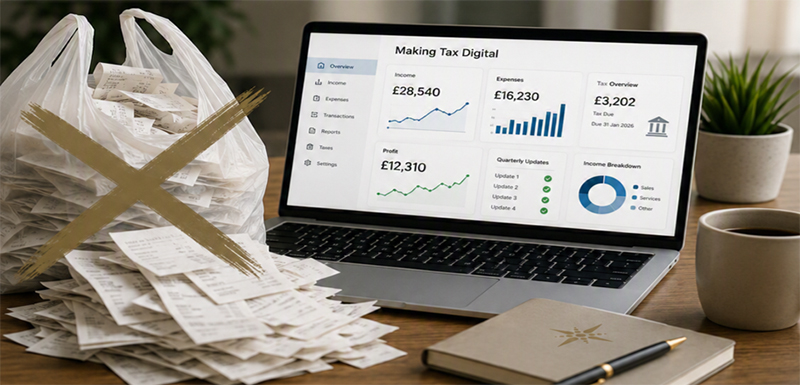
And please, retire the carrier bag of receipts.
At Financial Angels, we help landlords and sole traders check whether MTD applies, choose the right software, clean up their records and build a simple process that works in real life.
If you are unsure whether MTD applies to you, or you know you are caught but have not started preparing, speak to us now.
Not the night before the deadline.
The Financial Angels Difference
You do not need to track every HMRC update, that is our job.
We focus on what matters, when action is required, and how to deal with it properly the first time.
From tax planning and cashflow to compliance and governance, our role is to keep you two steps ahead, not two steps behind.
To partner with us and see how we can work together, please contact us here